
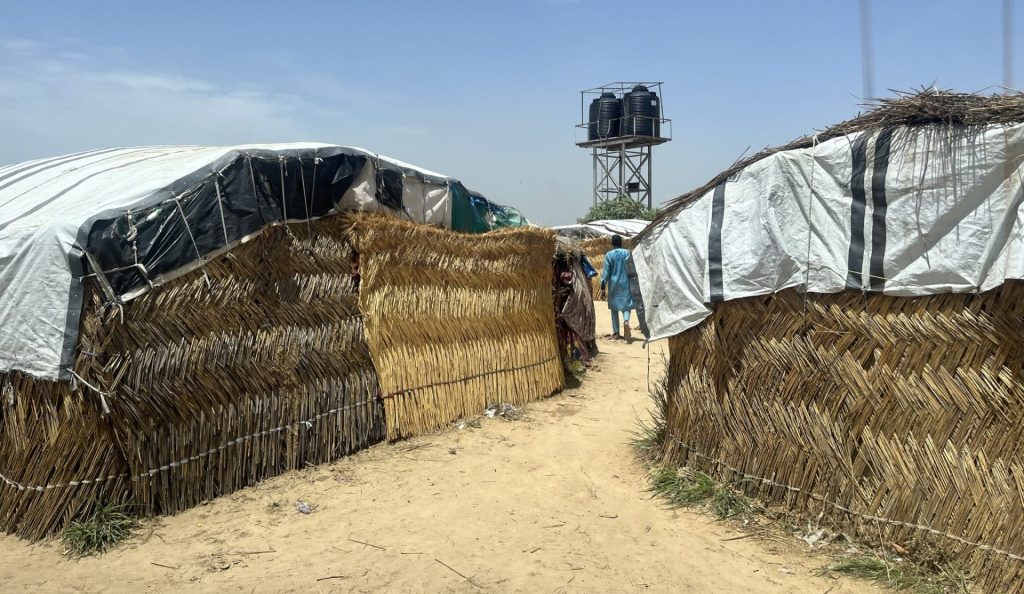
Results from the field trial of Guardian™ spatial repellent emanator have been published in the Lancet Infectious Diseases, which adds to the growing evidence for the use of this vector control tool in humanitarian settings.
MENTOR has for many years led the piloting and testing of innovative tools to protect people and prevent diseases in humanitarian contexts. In these settings, relying on one vector control tool is often not suitable and can cost lives. Logistical, access and security challenges pose significant barriers to implementing quality, high coverage vector control.
Addressing these gaps requires an integrated vector control approach but also, innovative tailored tools to fit specific shelters and remain effective in conditions typical of displaced persons camps.
Long-lasting spatial emanators have been proven to reduce malaria incidence in stable settings but its efficacy in humanitarian settings required adequate assessment. This study that took place in displacement camps in Borno State, Nigeria in 2023, shows that during the six-month follow-up camps using spatial emanators had a significant reduction in malaria infection incidence compared with control camps (incidence rate ratio 0.713, p=0.001) – about 30% fewer infections overall.
Children in intervention camps had a lower risk of getting their first malaria infection during the study period (hazard ratio 0.775), equivalent to about 22.5% protective efficacy.
Spatial emanators were also found to be highly accepted by communities using them, strengthening the growing evidence for the public health value of this tool in humanitarian settings.
“The importance of this type of study cannot be overstated as millions of people are still at high risk of malaria and other vector-borne diseases. Growing humanitarian crises, climate change and mass displacement of people are creating conditions where traditional vector control tools are often not effective or suitable. Having a new, effective tool to strengthen the toolbox is potentially a game changer in reaching millions of people with life-saving disease control.” – Richard Allan OBE, PhD, Chair of the Board, The MENTOR Initiative.
Link to the paper: https://lnkd.in/eH4ASYWf
MENTOR is grateful to everyone who participated in the study, the Borno State Ministry of Health, the study team and authors.
Details of the study
Setting and design:
- 24 camps for internally displaced people in Maiduguri, Nigeria
- 12 camps received the intervention (spatial repellent emanators)
- 12 camps served as controls (no intervention)
- 1,655 children aged 6-10 years participated (842 intervention, 813 control)
N.B in this case Spatial Emanators were distributed on top of residual LLINs. Prior to distribution all study participants received an appropriate course of ACT to clear parasites. Children aged 6-10 were selected as those 0-5 years were targeted with annual Seasonal Malaria Prophylaxis.
Intervention:
- Guardian TM spatial emanators were installed in 50 eligible households per intervention camp
- These devices release transfluthrin that repel mosquitoes
- Designed to remain effective for 12 months and therefore the entire 6-month trial duration
Major findings:
- In the six months of follow up post distribution the estimated protective efficacy of spatial emanators against first time malaria infection was 22.5%.
- Pyrethroid resistant Anopheles density and blood feeding was significantly reduced.
- Spatial emanators were highly accepted by camp residents due to perceived entomological impact, this included a willingness to pay for spatial emanators in the future.
The significance:
Context of humanitarian crises:
- By 2030, two-thirds of the world’s poorest populations will live in areas affected by conflict and violence.
- Around 305 million people need humanitarian aid globally.
- Forcibly displaced populations face severe malaria risk, especially when moving into high-transmission areas.
Advantages of spatial emanators: These devices are particularly suited to humanitarian emergencies because they:
- Are lightweight, compact, and easily transported
- Work in diverse shelter types including tents
- Can be rapidly deployed
- Don’t require behaviour change from residents
- Can be stockpiled for emergency response
- Cannot be repurposed for other uses
Broader implications:
This study provides the first evidence that spatial emanators can effectively control malaria in African humanitarian crisis/ camp settings. The findings are particularly important because:
- Populations in vulnerable settings: The study demonstrates a practical tool to prevent malaria in humanitarian emergency contexts.
- Expanding the toolbox: These results support adding spatial repellents to the (limited) range of vector control tools suitable for humanitarian emergencies.
- Growing evidence base: This adds to previous trials from Kenya, Indonesia, Peru, and Syria showing protective effects of spatial repellents against various vector-borne diseases, specifically the first epidemiological efficacy data for spatial emanators in West Africa.
The researchers conclude that spatial emanators should be considered for deployment in humanitarian crisis settings to expand malaria control options beyond traditional interventions.
Caption: Shelters in one of the IDP camps in Maiduguri where the trial of SC Johnson’s second-generation spatial repellent took place.