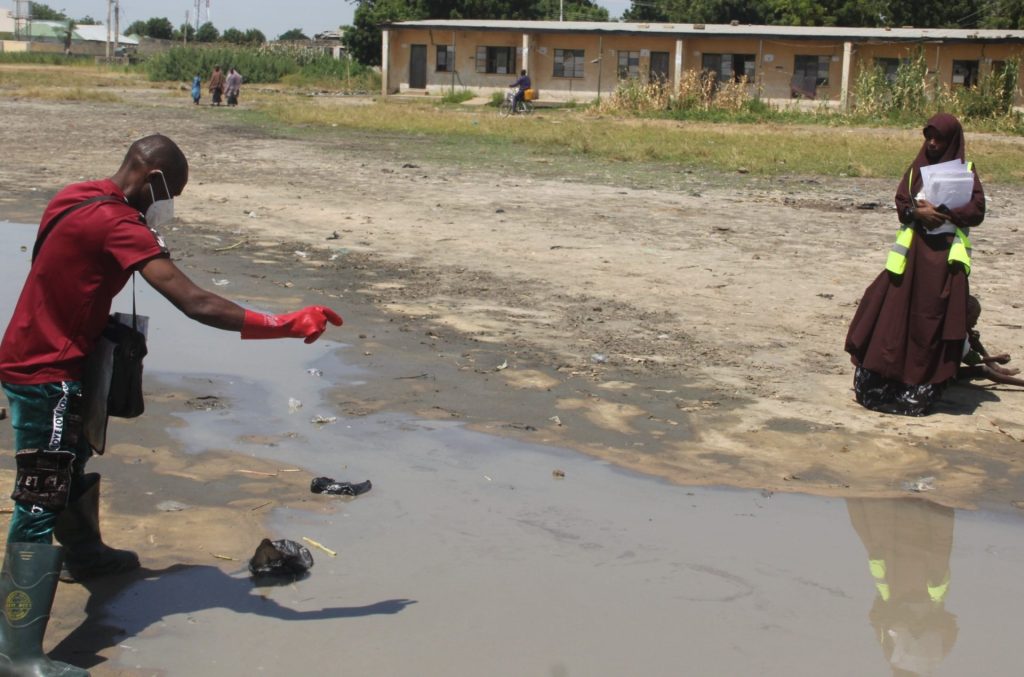
In Goni Damgari, Maiduguri, malaria remains a major public health challenge with mosquitoes thriving in open breeding sites – especially during the rainy season.
To address the high risk of malaria in the region, MENTOR supported the Borno Ministry of Health and State Malaria Elimination Programme to implement vector control activities over four months in 2025.
One of these was targeted larviciding at breeding sites, which effectively reduced the mosquito population and helped protect communities from vector-borne diseases. Trained vector control teams carried out activities across identified breeding habitats within Goni Damgari, protecting around 13,000 people at most risk of malaria and other vector-borne diseases.
Using environmentally safe larvicide granules, they treated stagnant water bodies, gutters, and open drainage systems to interrupt mosquito breeding and prevent larvae from maturing into adult mosquitoes.
Hajja Falmata Bukar, Leader of the Goni Damgari Women’s Group, said at the feedback session:
“We are very happy and amazed by the results of the larviciding activity. It is wonderful to see that just by applying these granules in open breeding sites, the number of mosquitoes in our community has reduced greatly. Before, we could hardly sit outside or sleep at night without mosquito nets, but now things have changed. We can rest comfortably without constant mosquito bites. The women in our community especially appreciate this effort because it has made our homes and surroundings more comfortable and healthier for our children.”
This activity forms part of the integrated vector management programme in Borno State supported by the Nigerian Humanitarian Funding. It complements other disease prevention activities that have taken place such as Indoor Residual Spraying and health promotion in the community.
The programme also included training rapid response members to identify diseases such as cholera, measles and diphtheria through household visits; and training community educators to improve awareness of malaria prevention and hygiene by delivering sessions in the community, households and in health facilities.